APIPod
APIPod: Unified AI API platform with smart routing, 100+ models, and scalable solutions for developers.

English
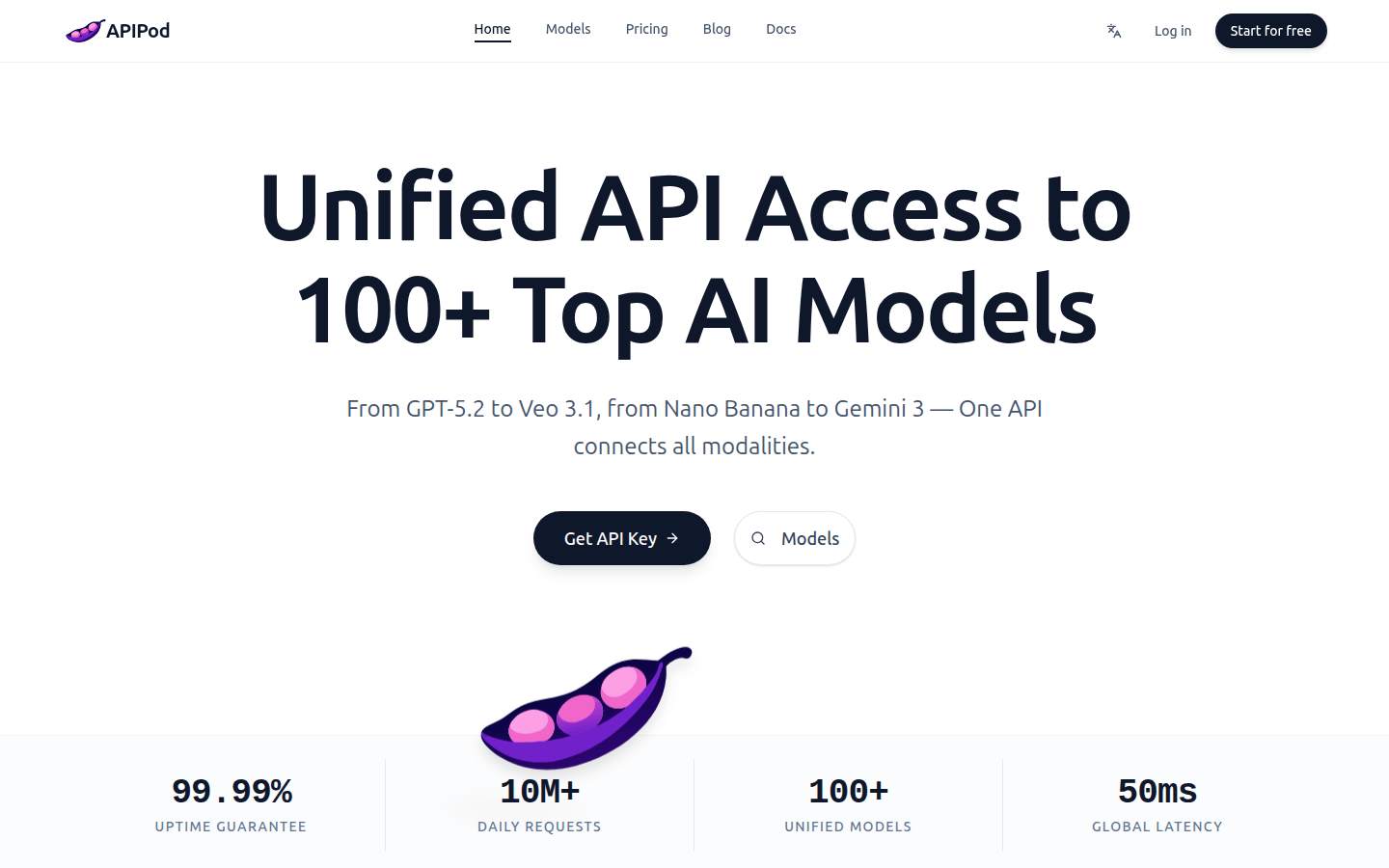
APIPod is a high-performance AI API aggregation platform. Its importance lies in providing unified access to multiple AI models. It can connect multiple AI model providers such as OpenAI, Anthropic and Google to ensure high availability and reliability of the system through technologies such as intelligent multi-channel routing and circuit breaker protection. The platform supports multiple functions such as AI chat, video, image and music generation, covering all AI modalities. In terms of price, it provides a free package and adopts a pay-as-you-go pricing model. Its positioning is to provide developers with one-stop AI solutions to reduce development costs and improve development efficiency.
Demand group:
["Developers: For developers, APIPod provides a unified API interface, eliminating the need to develop and maintain separate interfaces for different AI models, reducing development costs and difficulties. At the same time, its intelligent multi-channel routing and circuit breaker protection functions can ensure the high availability and reliability of the system, allowing developers to focus on the development of business logic.", "Enterprise users: Enterprises can centrally manage all AI traffic through APIPod 's enterprise AI gateway to achieve compliance, logging, and expense management. In addition, the platform supports batch generation of blog posts, marketing copy, and social media images, etc., to improve the enterprise's content production efficiency.", "Creative workers: Creative workers can use the various AI models provided by APIPod , such as text-to-image, text-to-video generation models, to quickly transform ideas into actual works to meet the needs of creative platforms, marketing activities, and social media content creation."]
Example of usage scenario:
Develop autonomous AI agents: Developers can use APIPod 's unified API to chain-call multiple models, such as GPT-4, Claude 3, etc., to build AI agents that can reason, code and perform tasks autonomously.
Automated content production: Enterprises can use APIPod ’s API to batch generate blog posts, marketing copy, and social media images to improve content production efficiency.
Creative video production: Creative workers can leverage APIPod ’s text-to-video models, such as Sora 2, Veo 3.1, etc., to convert text and images into high-quality videos for creative platforms, marketing campaigns, and social media content creation.
Product features:
Unified API access: More than 100 top AI models, including GPT-5.2, Veo 3.1, Nano Banana, Gemini 3, etc., can be accessed through one API, covering multiple modalities such as text, images, videos, etc., which greatly simplifies the development process and eliminates the need for developers to configure separate interfaces for different models.
Intelligent multi-channel routing: Configure multiple back-end channels for each model, and the system will automatically distribute requests to multiple provider channels based on policies such as polling, weighted random, least connections, fastest response, or failover priority to reduce costs and improve system stability to ensure high availability of services.
Circuit breaker protection: It has real-time health monitoring function. When three consecutive failures are detected, it will automatically trigger a 30-second automatic circuit interruption to temporarily stop routing traffic to the fault channel to prevent cascading failures and ensure that applications can still run reliably when problems arise with the provider.
Observability platform: Provides complete monitoring indicators such as real-time request logs, token usage statistics, and cost analysis dashboards to help developers gain an in-depth understanding of the performance and cost of AI applications and conduct targeted optimization.
Supports the development of multiple AI applications: It can be used to build various applications from simple chatbots to complex multi-modal workflows, such as autonomous AI agents, automated content production, and enterprise AI gateways, to meet development needs in different scenarios.
Usage tutorial:
1. Register an account: Visit APIPod ’s official website https://www.APIPod.ai, click the registration button, fill in the relevant information to complete the registration.
2. Obtain the API key: After successful registration, log in to the account and obtain the free API key in the console.
3. Select a model: According to your own needs, choose an appropriate model from more than 100 AI models provided by APIPod , such as text generation model, image generation model or video generation model, etc.
4. Integrate API: Use the obtained API key to integrate APIPod 's API into your own application. Since APIPod is fully compatible with the OpenAI SDK, no code changes are required.
5. Testing and optimization: After the integration is completed, conduct testing, view real-time request logs, token usage statistics, cost analysis and other indicators through APIPod 's observability platform, and optimize the application based on these indicators.