Leapility
Empower experts with AI agents. Create, scale, and share knowledge easily. Boost efficiency and expertise.

English
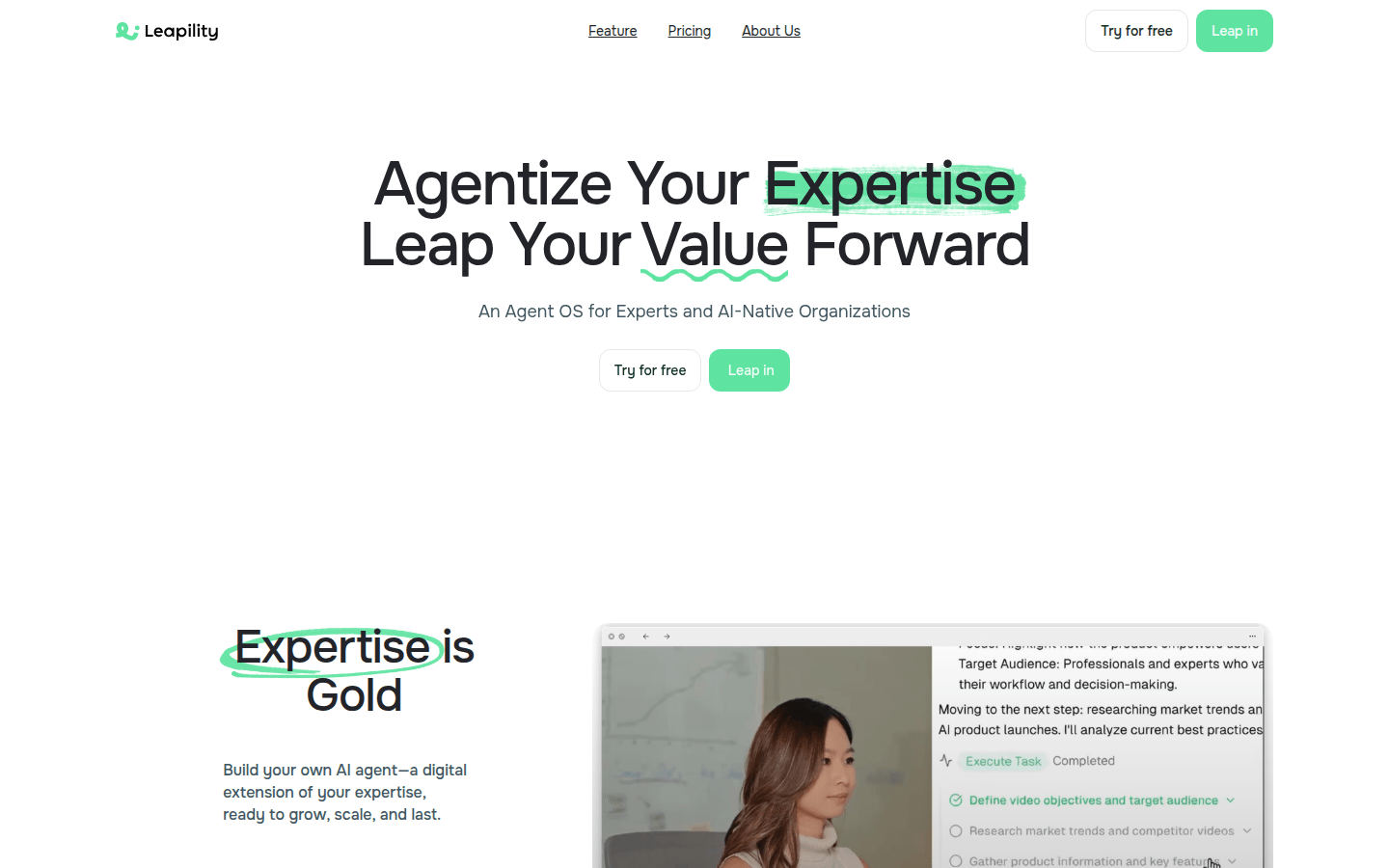
Leapility is an Agent OS for experts and AI-native organizations. Its importance lies in enabling professionals to make full use of their own expertise, amplified and expanded through AI agents. The main advantages include being able to easily create your own AI agent, having a multi-modal knowledge base, a natural language workflow editor, etc., which can improve work efficiency and achieve knowledge scale. The product background is to meet the needs of professionals for AI technology. In terms of price, there is a free version and a Pro version. The free version is $0/user/month and the Pro version is $20/user/month. The product positioning is to help experts and organizations enhance their professional value and realize the digitization and intelligence of knowledge.
Demand group:
["Experts: Experts have rich professional knowledge. Leapility can transform their knowledge into AI agents, realize the digitization and scale of knowledge, help them exert professional value on a larger scale, and at the same time earn income through the certified expert network.", "AI native organization: Organizations can use Leapility 's multi-modal knowledge base, natural language workflow editing and other functions to improve work efficiency, achieve intelligent management, and can collaborate and communicate with other organizations through the agent market.", "Professional workers: such as employment risk consultants, beauty sales coaches, AI project analysts, etc., they can use Leapility to create AI agents suitable for their own work scenarios to assist them in completing their work and improve the accuracy and efficiency of their work."]
Example of usage scenario:
Employment risk advisors use AI agents created by Leapility to quickly identify policy risks and provide immediate compliance guidance.
Beauty sales coaches use Leapility 's AI agents to simulate customer chats, constantly optimize sales techniques, and improve sales success rates.
AI project analysts use Leapility 's AI agent to visualize the potential of AI projects from multiple dimensions, providing a clear basis for project decisions.
Product features:
Expert knowledge is transformed into AI agents: Users can transform their professional knowledge into AI agents. These agents are like digital extensions of users’ professional capabilities and can continue to grow, expand and persist, helping users use their knowledge more efficiently at work.
Multi-modal knowledge base construction: This function allows users to capture documents, visual materials, contextual information, etc., providing comprehensive knowledge support for AI agents, enabling agents to understand various complex situations like users.
Natural language workflow editing: Build workflows through natural language. Users can describe the workflow in prose language according to their own way of thinking, and the system will automatically convert it into an executable workflow that conforms to the user's daily logical habits.
Natural language agent creation: Users only need to describe the workflow once, Leapility can generate a working AI agent that follows the user's intentions, greatly reducing the time and difficulty of developing AI agents.
Rich tool integration: Within a workspace, users can integrate tools such as search, creation, and action for AI agents to expand the agent's capabilities and enable it to complete more diverse tasks.
Agent market publishing and sharing: Users can publish the AI agents they create to the market for others to subscribe, collaborate and conduct secondary development based on them, promoting the sharing and exchange of knowledge.
Certified Expert Network: This is a platform where users can be recognized for their expertise and earn money for helping others through their own AI agents.
Usage tutorial:
Step 1: Visit Leapility official website (https://www.Leapility.com/) and click "Try for free" to start the free trial.
Step 2: Register an account on the platform and log in.
Step 3: Use natural language to describe the workflow and create your own AI agent based on your professional knowledge and work needs.
Step 4: Add the required knowledge and data to the AI agent, which can capture documents, visual materials, etc. through a multi-modal knowledge base.
Step 5: Leverage rich tool integration capabilities to expand search, creation, and action capabilities for AI agents.
Step 6: Test, adjust and improve the created AI agent to ensure that it meets your intentions.
Step 7: If necessary, publish the created AI agent to the agent market to share and collaborate with others.