MedAlly – All
MedAlly: AI-powered medical assistant for doctors. Save time, boost accuracy, and focus on patients.

English
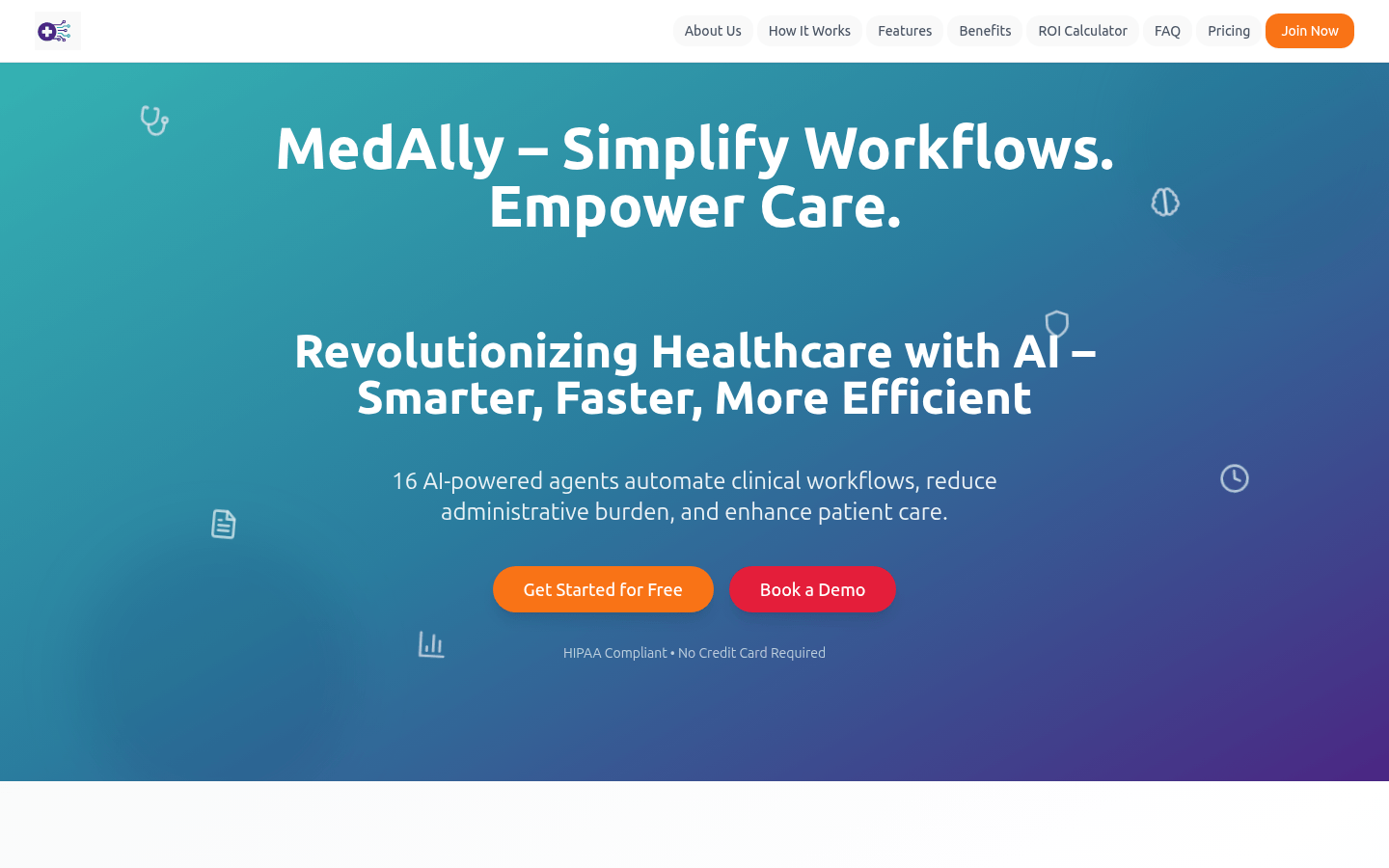
MedAlly is an AI medical assistant specially built for doctors, dedicated to revolutionizing medical workflow through artificial intelligence technology. Its importance lies in addressing issues such as excessive administrative burden, diagnostic challenges, revenue loss and burnout faced by physicians. Key benefits include reducing physician documentation time by 70%, improving diagnostic accuracy by 93%, optimizing revenue by 35%, and integrating seamlessly with all major electronic medical record systems. The product background stems from the medical industry's need to improve efficiency and medical quality. In terms of price, you can start using it for free, but the specific pricing is not mentioned in detail on the page. The product positioning is to help doctors simplify their work processes and focus on patient care.
Demand group:
["Doctors: Doctors face a lot of paperwork and diagnostic pressure. MedAlly can help them reduce documentation time and improve diagnostic accuracy, so that they have more time to focus on patient care and reduce professional burnout.", "Medical institutions: Medical institutions can optimize workflow, improve medical quality, reduce revenue loss, and improve overall operational efficiency by using MedAlly.", "Medical managers: Medical managers can use MedAlly's data analysis and reporting functions to better manage medical resources and make decisions."]
Example of usage scenario:
After using MedAlly, doctors at a certain hospital saved 2 hours of documentation time every day, were able to communicate more with patients, and improved patient satisfaction.
One clinic optimized revenue and reduced coding errors and missed billings with MedAlly’s automated coding and billing capabilities.
A doctor used MedAlly's predictive differential diagnosis function to accurately diagnose rare diseases, avoiding misdiagnosis and treatment delays.
Product features:
AI-driven clinical documentation: With the help of advanced AI technology, it automatically converts doctor-patient conversations into structured SOAP notes, supports 50 languages, understands medical terminology and accents, reduces doctors' workload by 80%, saves doctors 2 hours a day, and significantly reduces documentation time.
Optimize clinical documents: Utilize 20 compliance templates to pre-populate and automatically structure medical history and physical examination, SOAP, discharge summary and consultation notes, implement real-time AI structuring to ensure consistency, easily meet regulatory standards, and turn tedious paperwork into a one-click process.
Laboratory follow-up and predictive result analysis: Automatically mark key laboratory values, predict patient risk and generate instant structured reports, automatically detect abnormal results and risk factors, reduce delays in follow-up and treatment, and increase the speed of marking key findings by 3 times.
Predictive differential diagnosis and clinical ranking: A disease ranking AI engine with 93% accuracy marks neglected diseases, provides doctors with instant AI-supported differential diagnosis, and implements AI-driven triage to speed up decision-making, ensure that rare diseases are not missed, and significantly reduce the misdiagnosis rate.
Diagnostic planning and priority test recommendation: Recommend the most effective diagnostic tests based on patient conditions while reducing unnecessary procedures, optimizing test selection to improve efficiency and accuracy, reduce redundant diagnoses, and improve treatment outcomes.
Usage tutorial:
1. Integrate MedAlly with your electronic health record (EHR) system. It supports all major EHR systems such as Epic, Cerner, Allscripts, etc., through secure API connections, enabling one-click integration, with an average setup time of 15 minutes and 24/7 technical support.
2. Let AI handle documentation, diagnostics and administrative tasks. MedAlly's 16 AI agents work together to automate clinical documentation, assist with diagnosis, and streamline administrative tasks such as generating SOAP notes in real time, automating ICD-10 and CPT coding, and providing AI-driven differential diagnosis recommendations.
3. Focus on patient care. While AI handles background work, doctors can spend more time with patients, improving treatment results and reducing professional burnout.