TeleChat3
TeleChat3: High-performance AI model for NLP, code, and creative tasks.

English
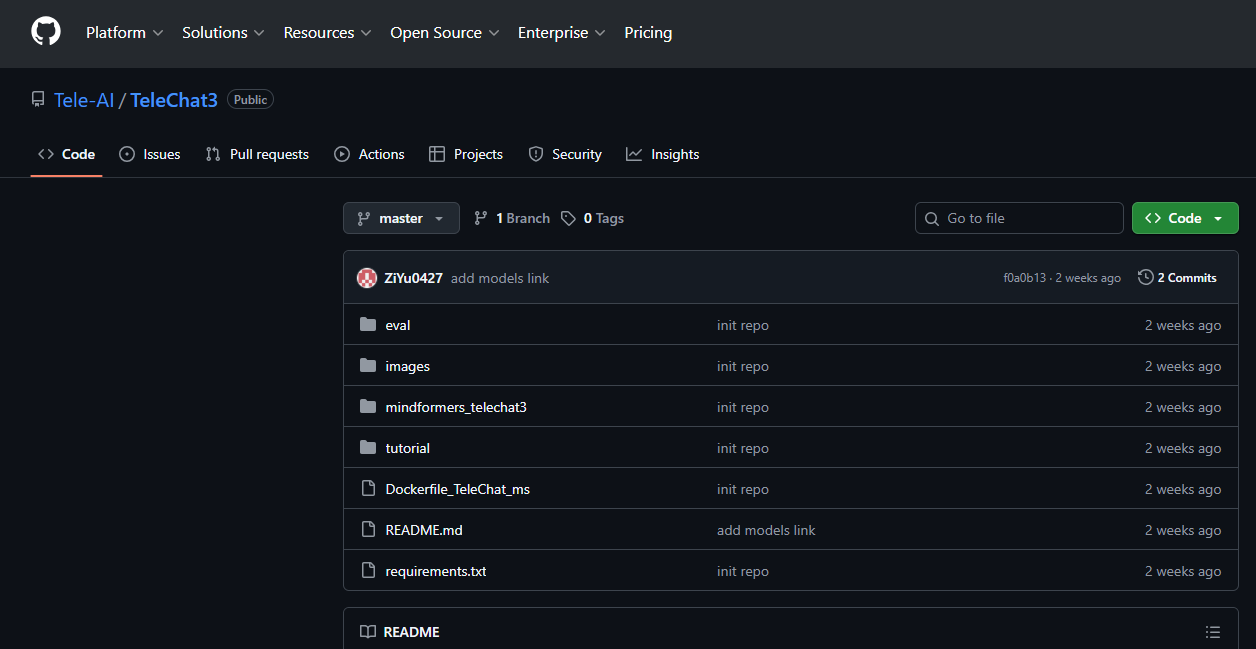
Star Semantic Large Model - TeleChat3 is a high-performance large language model developed by China Telecom Artificial Intelligence Research Institute, focusing on natural language processing tasks. This model is trained based on domestic computing power, has strong reasoning and fine-tuning capabilities, and is suitable for various application scenarios. The product is committed to providing developers with efficient and flexible AI solutions, especially demonstrating excellent performance in multiple dimensions such as knowledge, creation, instructions, and code.
Demand group:
"This product is suitable for natural language processing, AI developers and researchers, especially those who need to perform text generation, knowledge question and answer, code generation and other tasks. TeleChat3 powerful reasoning capabilities and flexible fine-tuning options make it an ideal tool in research and development."
Example of usage scenario:
Use TeleChat3 for text generation, suitable for writing assistant applications.
In the field of education, knowledge question and answer services are provided through TeleChat3 .
Develop a code assistant tool to take advantage of TeleChat3 's code generation capabilities.
Product features:
High-performance reasoning: supports single-card and multi-card reasoning, and optimizes long text processing.
Fine-tuning support: Use LLaMA-Factory for model fine-tuning and weight merging.
Adapted to domestic hardware: Supports Ascend Atlas 800T A2 training server to achieve efficient training and inference.
Multiple ability evaluation: Comprehensive evaluation in multiple dimensions such as knowledge, mathematics, and creation to demonstrate excellent model performance.
Service-based reasoning: supports the fast reasoning and service functions of vLLM and SGLang frameworks.
Usage tutorial:
Download the model and corresponding libraries.
Import the required libraries such as transformers and torch.
Load the model and tokenizer, and set up the inference device.
Prepare input data and format it into the structure required by the model.
Call the model generation method to obtain the generated results.